

Jessica Hsiung, Scientific Illustrator at AAFC, holding an illustration of the beetle Neomida bicornis.
People tend to think of science and art as being two complete opposites, with “science” representing the world of facts and figures, and “art” the world of fiction, visual beauty and imagination.
The truth is that science and art have always been closely related. From Charles Darwin’s use of animal illustrations as part of his theory of natural selection, to Leonardo DaVinci’s masterful illustrations of anatomy and engineering, the worlds of science and art have always been deeply influenced by each other.
The space where these two worlds meet is where you can find a unique and fascinating profession: the scientific illustrator. It’s a subject that has always captivated Jessica Hsiung, who has held this role at Agriculture and Agri-Food Canada (AAFC) since 2017. As the department’s sole scientific illustrator, Jessica has built an impressive artistic portfolio in support of the Science and Technology Branch.
After studying both biology and fine arts as an undergraduate student, Jessica received a Postgraduate certificate in Science Illustration from California State University Monterey Bay, followed by a Masters in Medical Art at the University of Dundee. This was followed by internships at the Royal Ontario Museum and in the entomology department of the prestigious Smithsonian Museum of Natural History in Washington, DC, as well as a position at the McGill University Health Centre.

Jessica visually “reconstructing” a specimen in preparation for illustration.
Over the years, Jessica has had the opportunity to learn from some of the most gifted names in her profession. This included strong support and encouragement from her mentor Ed Bell, who has guest lectured at California State University Monterey Bay, created 3D animations on planetary science for the NOVA documentaries on the U.S.-based Public Broadcasting Service (PBS) and contributed as art director at Scientific American magazine.
Today, Jessica’s illustrations mainly serve to support AAFC’s Canadian National Collection of Insects, Arachnids and Nematodes, creating illustrations for research publications. Her work is included in research papers describing new species or comparing existing species, and in book and journal covers and figures. Additionally, Jessica illustrates diagrams and maps for guides and is an expert in taking and editing photos of specimens.
The goal of scientific illustration is to convey scientific concepts using visual means, prioritizing accuracy and precision. This begs the question: if accuracy is important, why don’t we just use high-resolution digital photography?
The answer is because the illustrator is often called upon to emphasize a certain aspect of the subject in order to illustrate a scientific finding the researcher is attempting to communicate to the reader. Using tactics like shading, contrast, size, or perspective, an illustrator can draw out these important elements to make them more obvious to the viewer. This need for the scientific illustrator to have a nuanced understanding of the subject matter being illustrated is a key element of the craft, and in effect makes them as much a teacher as an artist.
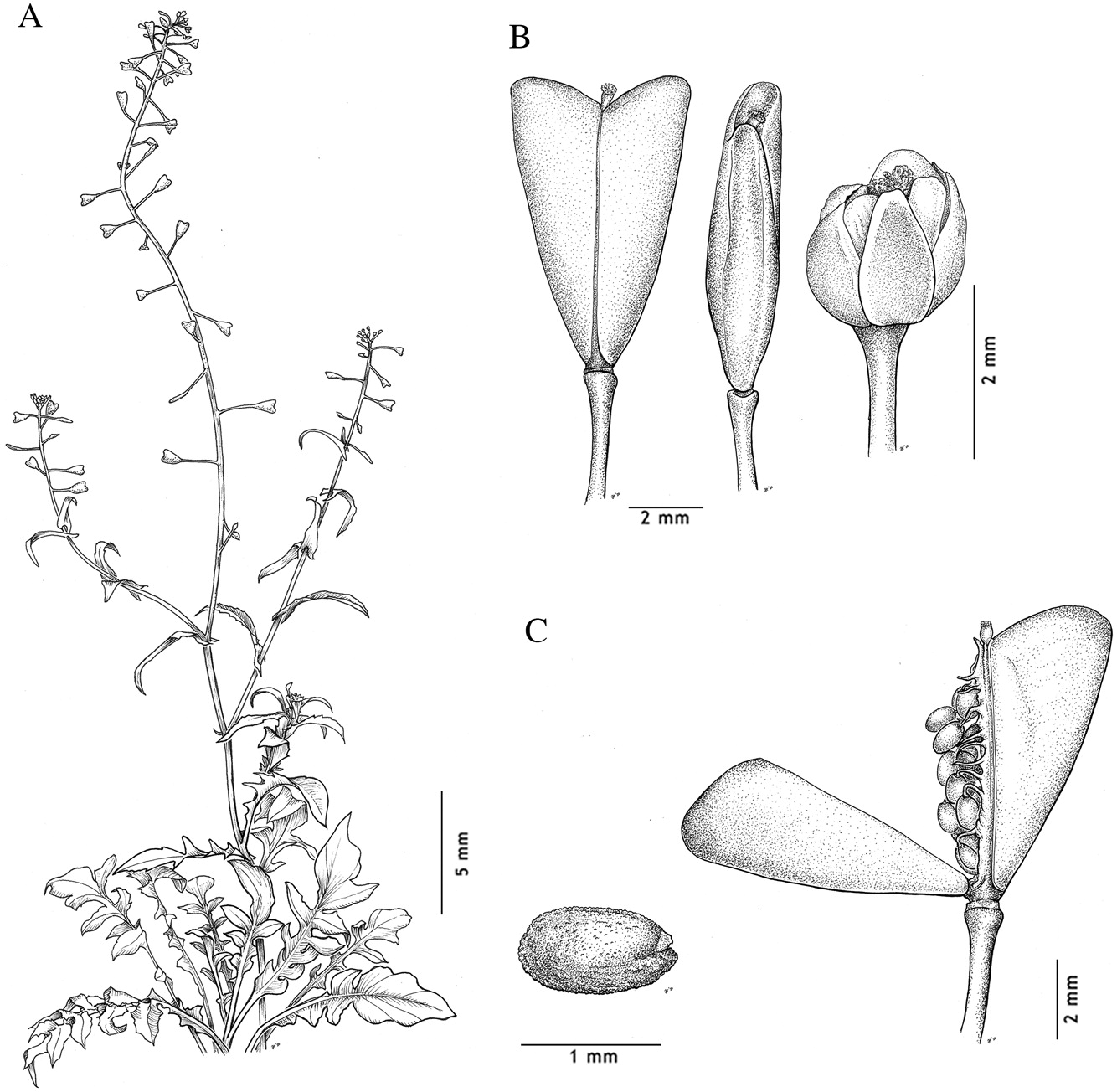
Jessica’s illustration of a mature Capsella bursa-pastoris plant's stages of life.
For an entomology project, Jessica usually receives a specimen (pinned or preserved in alcohol or a slide) or photo, which in their original forms are not ready for their close-ups. “Specimens can be damaged or not in the optimal view, with legs all bent and hidden by other structures, for example,” she explains. "It’s my job to ‘reconstruct’ it visually, to create the ‘perfect’ specimen, in the ideal view, that highlights what’s needed for the publication.”
Plant specimens are usually live and potted, and Jessica is tasked with drawing the entire plant (habitus) as well as the individual parts (flowers, rosette, seeds, pods etc.). Since the plant is living and it is changing every day, she must work quickly and will often take reference photos to help her in later stages of the project. Her goal is to keep what is important while making sure all the structures are clear and accurate, and the parts in the illustration are arranged so they look aesthetically pleasing. Jessica is continuing a proud tradition of scientific illustration at AAFC, which began with Faith Fyles, the department’s first botanical artist.
Faith Fyles: AAFC's first botanical artist
First hired as an assistant seed analyst, Faith later transferred to the Central Experimental Farm as an assistant botanist in 1911. In 1914 Faith embarked on a tour of western Canada to collect and catalogue plant specimens, which she used to create the landmark publication “Principal Poisonous Plants of Canada.” Filled with Faith’s exquisite watercolour renditions of native plants, this guide provided invaluable information for farmers and naturalists. In 1920, Faith officially became the department’s first botanical artist.
Even with the distance of time between the two artists, Jessica still feels a connection with her predecessor. “I enjoy looking at her work and seeing her science-based artistic choices, like where she chose to add detail to emphasize characteristics unique to the plant,” Jessica says. “I feel that even a hundred years later, these are things I also think about in my process when illustrating a specimen, so it’s still very relevant to me today.”
While recognizing it is a very specialized field, Jessica is quick to recommend it to any student with a fine artistic hand and a keen eye for detail. “It’s a rewarding career because you are contributing to the world of science, helping move research forward, and aiding different audiences absorb complex knowledge.”
Get more Agri-info
- Want more stories like this? Explore what else Agri-info has to offer.
- Interested in reporting on this story? Contact AAFC Media Services at aafc.mediarelations-relationsmedias.aac@agr.gc.ca to arrange an interview with one of our experts.