Authors:
J. Liu, D. Lapen, P. Gagnon, C. Sheedy, A.J. Cessna, A. Farenhorst, N. Newlands, D.A.R. McQueen
Status:
National Coverage, 1981-2021
Table of Contents
- Summary
- The issue
- Why it matters
- The indicator
- Limitations
- Results and Interpretations
- Response Options
- References
Summary
Pesticides are applied to protect crops from damage caused by weeds, insects, and diseases. Applied pesticides may move from cropland to the broader environment, and affect aquatic wildlife and drinking water quality. The Indicator of the Risk of Water Contamination by Pesticides (IROWC-Pesticides) has been developed to evaluate the relative risk of water contamination by pesticides across Canada’s agricultural landscapes. The indicator accounts for the input of pesticides on cropland and for the transport of pesticides to surface water and groundwater, which depends on the chemical properties of the pesticide, soil-landscape characteristics and climate/weather.
The results at the national scale over the 1981-2021 period indicate that the risk of groundwater contamination is generally much lower compared to surface water contamination. Results suggest that on a national basis, the overall risk of water contamination from pesticides is increasing. From 1981 to 2006, the overall risk of water contamination remained stable, with about 90% of Canadian cropland at lower risk (rated as low or very low-risk classes). By 2021, however, this risk had increased, with several areas moving into higher-risk classes. From 1981 to 2021, the proportions of lower-risk classes decreased from 90% to about 70%, primarily due to an increase in the area treated by pesticides.
The regions with the highest IROWC-Pesticides risk are those with both a large percentage of the agricultural land treated with pesticides, and a relatively wet climate, generating relatively more surface runoff. Despite large areas treated by pesticides, the risk remained generally low or very low across much of the Prairies, mainly due to the dry climate, restricting pesticide movement due to runoff events.
The issue
Pesticides help agricultural producers reduce losses caused by weeds, insects, and plant diseases. Pesticides applied on the farm may move into the broader environment, however, and contaminate surface and ground waters, representing a potential risk to aquatic species and to human health by affecting the quality of drinking water.
Several physical, chemical and biological processes are involved in influencing the extent of transport of pesticides, by wind or water, from the application site to other parts of the ecosystem (Figure 1). For most processes, the impact is not precisely known at a given site because of a lack of data collected at the field scale. Canada is a country with a broad range of climatic and physiographic conditions, and with a wide range of agriculture practices. This diversity of practices, together with uncertainties stemming from complex, location-specific natural processes, makes it challenging to evaluate the risk of water contamination by pesticides.
Description of Figure 1
The figure portrays the Processes involved in the movement of pesticides from the site of application. The image shows a drawn landscape with text naming each process and an arrow pointing to where it would happen on the landscape. These are the processes mentioned, from left to right: Dry deposition, Chemical and microbial degradation in soil, surface runoff, application droplet and vapour drift, Rainfall washout, Leaching and preferential flow, Wind erosion of treated soil, Metabolism in the crop, Post-application vapour drift, and lastly, Photodegradation.
Agricultural practices are continuously evolving, so it is important to periodically evaluate the risk of water contamination by pesticides. Since 1981, cropland area increased in Canada mainly due to the decline in the area under summer fallow and the conversion of pasture to cropland (Huffman and Eilers, 2010). Furthermore, new pesticides are being developed over time, some of which may have different active ingredients and levels of toxicity. In light of these compounding factors, an agro-ecosystem perspective and a robust methodology are required to reliably predict risk across space and time.
Why it matters
Within the Global Biodiversity Framework, Canada commits to reducing pollution risks due to excessive applications of nutrients and pesticides, which can induce cumulative negative effects on the general environment and harmful to biodiversity. Pesticides have been found in surface and ground waters in several monitoring studies across Canada (for example, Cessna et al., 2005; Lalonde and Carron, 2020; Sultana et al. 2018). The risk to aquatic species and humans exposed to pesticide residues in contaminated water has been evaluated for many pesticides used in Canada. However, toxicity varies substantially among pesticides, because it is determined not only by the specific chemistry of the ingredients, but also by the level, duration, and frequency of exposure to the pesticides, individually or in combination. In Canada, aquatic and drinking water guidelines have been established for only a few agricultural pesticides.
In addition to potential environmental impacts, whenever pesticides are lost to the broader environment, there is also an economic impact to producers. First, this ‘lost’ pesticide is not effectively protecting crops from pests and diseases, and crop losses due to pests are increased. Secondly, the cost of purchasing and applying the lost pesticide is a direct economic loss to producers.
The indicator
The Indicator of the Risk of Water Contamination by Pesticides (IROWC-Pesticides) has been developed to assess the relative risk of water contamination by agricultural pesticides in Canada. It is responsive to management practices that affect pesticide use, and pesticide transport by water. The indicator uses the Pesticide Root Zone Model (PRZM) (Suarez, 2006) to estimate the amount of pesticides moving into the surrounding environment, based on data on national pesticide use, pesticide application rates and management, soil and landscape characteristics, daily weather, and pesticide physical-chemical properties. Simulations are conducted at the Soil Landscape of Canada (SLC) polygon scale (Soil Landscapes of Canada Working Group, 2010). Given the uncertainty in the input data, a model was developed to generate PRZM input parameters from several scenarios of probable pesticide application and management, from a statistical distribution (Gagnon et al., 2014). For each SLC polygon and each year, 100 different scenarios are generated. This stochastic approach is a significant improvement to the model, and has been used since the fourth round Agri-Environmental Indicator Report (Clearwater et al, 2016).
For each simulated scenario, both the annual mass and the concentration of pesticides, in both surface runoff and in water infiltrating to one-meter depth, are calculated. The pesticides in surface runoff are in both the dissolved and particulate phases, while pesticides moving through the soil to groundwater are in the dissolved phase only. Because more than one pesticide may be applied on a site, the masses and concentrations calculated are the sum of all pesticides applied. Differences in toxicity between pesticides are not considered in the calculations. For each SLC polygon and each year, the median values from the 100 random scenario runs are selected.
Five classes of risk are defined from both the annual pesticide concentration and the annual mass of pesticide transported in water (Table 1). Because Canada has no water quality guidelines for pesticide mixtures, a limit concentration of 0.5 µg/L was used, which is the European drinking water quality guideline for pesticide mixtures (European Union, 1998). Both surface water and groundwater risks are assigned to classes according to Table 1, and the overall risk of water contamination by pesticides assigned to each SLC polygon is higher of the calculated surface water and groundwater risks.
Pesticide transported (g/Ha) | ||||||
|---|---|---|---|---|---|---|
<0.5 | 0.5-1.0 | 1.0-2.0 | 2.0-4.0 | >4.0 | ||
Concentration (ug/L) | <0.5 | Very low | Very low | Low | Moderate | High |
0.5 – 1.0 | Very low | Low | Moderate | High | Very high | |
>1.0 | Low | Moderate | High | Very high | Very high | |
Because the IROWC-Pesticides model and input data have been improving over the years, estimations were recalculated for each of the years when the Census of Agriculture was taken since the 1981 census year. Only SLC polygons consisting of at least 5% of cropland are considered, in any given census year.
Limitations
The PRZM is a one-dimensional model, meaning that simulations are made on a vertical soil layer although the slope factor has been used in the model. Estimates of pesticide concentration and mass of pesticide transported are representative of edge-of-field values and not values in the broader environment. The concentrations estimated are thereby significantly higher than the concentrations actually found in streams, in which significant dilution has occurred, so estimated concentrations cannot be directly compared with values from monitoring studies. IROWC-Pesticides must be considered as a relative indicator that can be used to provide an estimate of the spatial distribution of the risk of water contamination by pesticides and the change in those risk patterns over time.
Most relevant input data are available at a coarse scale; some input data required for the model are not available and were estimated based on expert advice. While the areas treated by pesticides in each SLC polygon are known from the Census of Agriculture, the amount of pesticides and the pesticide products used are not known at this scale. For this reason, the stochastic modeling approach was used to account for this uncertain information (Gagnon et al. 2014). In addition, field-scale land management practices like buffer strips, grassed waterways and surface water management (tiles and run-off control structures data is not available for inclusion in the modeling.
Pesticide transport processes such as preferential flow (impacting water and pesticide movement to depth) and atmospheric deposition directly to surface water, require data at a finer spatial scale than the SLC polygon. Consequently, considering these potentially important processes at the SLC scale can bring additional uncertainty to the indicator.
IROWC-Pesticides estimation would be more precise temporally, if pesticide-use data were periodically collected consistently from producers in representative regions across Canada. The pesticide-use data that were available were from the recent past (2002-2009), and it was assumed that their crop-specific application was consistent over the 1981-2021 period, though pesticide chemistry and application practice have changed over that time. Because the chemical properties of pesticides significantly impact their transport and fate in the environment, IROWC-Pesticides estimations for the earlier census years, for which no pesticide product and rate data were available, must be considered highly uncertain.
Because differences in toxicity between different pesticides are not considered in the current IROWC-Pesticides model, no direct interpretations can be made concerning toxicity risk, or the impact of changing chemistry on toxicity risk trends over time.
Results and Interpretations
For a majority of the SLC polygons, the risk of groundwater contamination, evaluated from mass and concentration of pesticides in infiltrating water at 1-m depth, was very low across Canada from 1981 to 2021, and was lower in infiltrating water at 1-m depth than in the edge-of-field runoff. Thus, the overall IROWC-Pesticides value assigned to each SLC polygon almost always represented the risk calculated for surface runoff water at the edge of the field.
In 2021, about 70% of cropland was considered at low or very low risk (Figure 2). Areas at very high risk, covering 5% of cropland, were mainly found on Prince Edward Island, in the mixedwood plains of Ontario and Quebec, the parkland region of the Prairies. Note that no SLC polygons from Newfoundland and Labrador had more than 5% cropland and hence risk is not calculated for this province.
Description of Figure 2
Figure 2 illustrates the relative risk of water contamination by pesticides on cropland under 2021 management practices, color coded based on the level of relative risk.
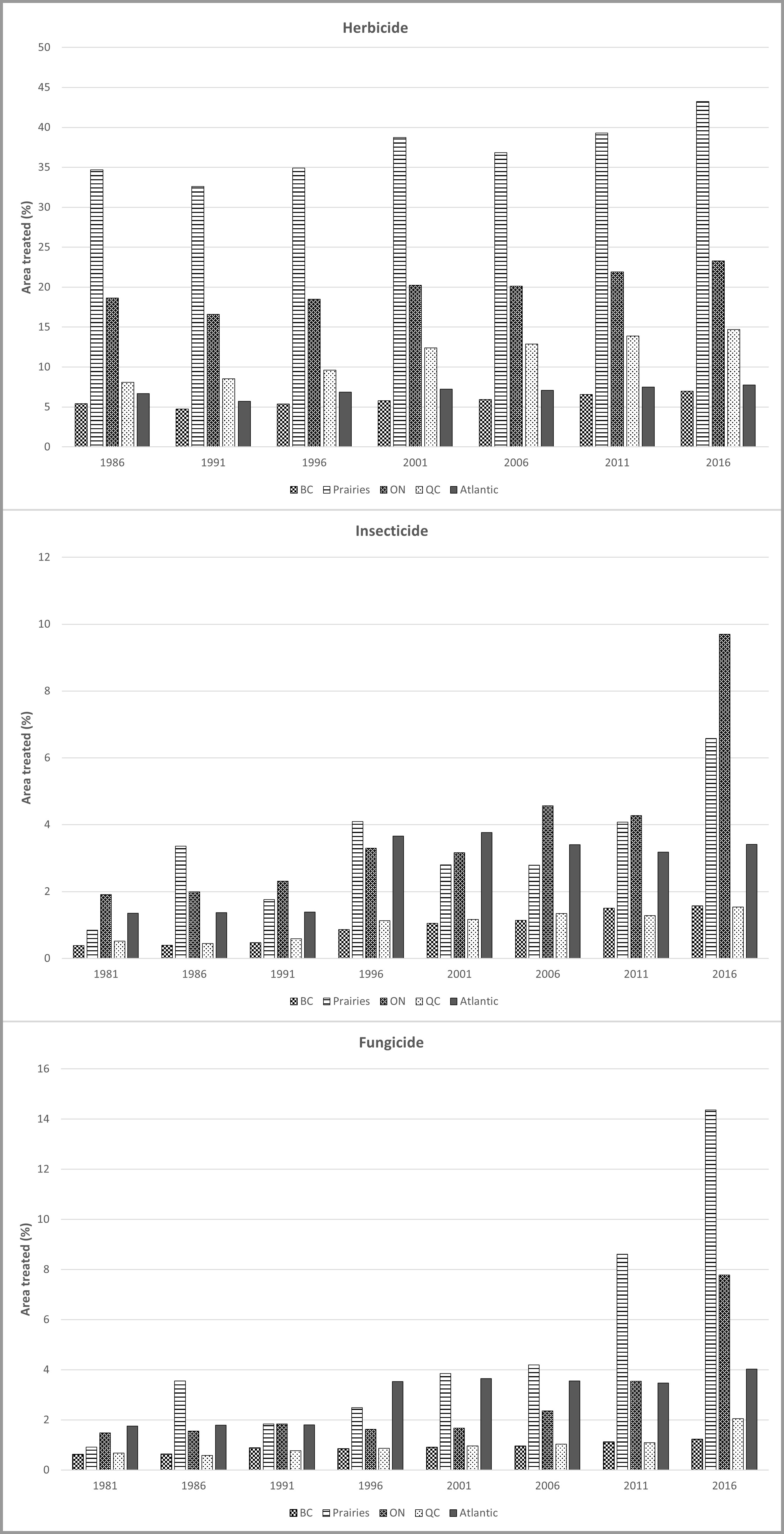
The risk of water contamination by pesticides is likely to be high if (i) there is a large amount of pesticides available to be transported, and (ii) there is an effective means of transportation. The amount of pesticides available depends notably on the area treated by pesticides as calculated from data available through the Census of Agriculture. Figure 3 shows the percentage of the agricultural land area treated by pesticides for all census years since 1981, by region (Prairies and the Atlantic) or province (British Columbia, Ontario, and Québec), based on similarities of climate and agricultural activities. The Prairies have the highest percentage of agricultural land treated with herbicides and fungicides, while Ontario, the Prairies and the Maritimes have the highest percentage of agricultural land treated with insecticides.
Figure 3 does not provide information on the number of pesticide applications per year, which depends notably on the crop and on the climate and hence can vary between regions across Canada. For example, because fruits are so vulnerable to insect infestations, fruit production usually requires more insecticide applications than field crop production. Also, to control a given crop disease, more fungicide applications are generally required in wetter climates (Bloomfield et al., 2006). British Columbia is characterized by two distinctly different agricultural regions, with high pesticide use rates in the lower Fraser River valley, where the climate is wetter and fruit production is significant, and very low rates in the larger, drier, northern agricultural regions, dominated by field crop production systems and pasture land.
Description of Figure 3
Pesticide Type | Year | British Columbia | Prairies | Ontario | Quebec | Atlantic |
|---|---|---|---|---|---|---|
Fungicide | 1981 | 0.62 | 0.92 | 1.48 | 0.68 | 1.76 |
Fungicide | 1986 | 0.64 | 3.55 | 1.56 | 0.58 | 1.79 |
Fungicide | 1991 | 0.89 | 1.84 | 1.84 | 0.77 | 1.80 |
Fungicide | 1996 | 0.85 | 2.49 | 1.62 | 0.87 | 3.53 |
Fungicide | 2001 | 0.91 | 3.85 | 1.67 | 0.96 | 3.65 |
Fungicide | 2006 | 0.96 | 4.19 | 2.36 | 1.03 | 3.56 |
Fungicide | 2011 | 1.12 | 8.61 | 3.54 | 1.09 | 3.47 |
Fungicide | 2016 | 1.23 | 14.36 | 7.78 | 2.05 | 4.03 |
Fungicide | 2021 | 1.11 | 15.54 | 8.93 | 2.11 | 3.77 |
Herbicide | 1981 | 4.61 | 21.75 | 17.82 | 6.10 | 6.31 |
Herbicide | 1986 | 5.42 | 34.67 | 18.65 | 8.09 | 6.66 |
Herbicide | 1991 | 4.75 | 32.61 | 16.59 | 8.53 | 5.72 |
Herbicide | 1996 | 5.38 | 34.90 | 18.48 | 9.60 | 6.86 |
Herbicide | 2001 | 5.78 | 38.74 | 20.24 | 12.40 | 7.23 |
Herbicide | 2006 | 5.92 | 36.86 | 20.12 | 12.87 | 7.08 |
Herbicide | 2011 | 6.57 | 39.29 | 21.91 | 13.89 | 7.48 |
Herbicide | 2016 | 6.96 | 43.24 | 23.27 | 14.70 | 7.76 |
Herbicide | 2021 | 6.79 | 43.37 | 23.03 | 13.48 | 6.99 |
Insecticide | 1981 | 0.38 | 0.85 | 1.91 | 0.52 | 1.35 |
Insecticide | 1986 | 0.39 | 3.36 | 1.99 | 0.45 | 1.37 |
Insecticide | 1991 | 0.47 | 1.76 | 2.31 | 0.59 | 1.39 |
Insecticide | 1996 | 0.86 | 4.10 | 3.30 | 1.13 | 3.66 |
Insecticide | 2001 | 1.05 | 2.80 | 3.16 | 1.17 | 3.77 |
Insecticide | 2006 | 1.14 | 2.79 | 4.57 | 1.34 | 3.40 |
Insecticide | 2011 | 1.50 | 4.08 | 4.27 | 1.28 | 3.18 |
Insecticide | 2016 | 1.57 | 6.58 | 9.70 | 1.54 | 3.41 |
Insecticide | 2021 | 1.28 | 6.93 | 6.87 | 1.29 | 3.20 |
The main means of transportation for pesticides is surface runoff. Surface runoff occurrence and intensity depends mainly on the amount of precipitation, and the soil moisture content when precipitation occurs. Soil moisture content is influenced by precipitation frequency, duration and intensity, by soil texture, and by farm management practices such as the type of crop grown and tillage practices. The average number of days with surface runoff in a given year, as simulated by the model PRZM, is higher for the Atlantic (annual average of 42 days), followed by Ontario and Quebec (~30 days), British Columbia (21 days), and the Prairies (11 days, Figure 4).
Description of Figure 4
Year | British Columbia | Prairies | Ontario | Quebec | Atlantic |
|---|---|---|---|---|---|
1981 | 24 | 9 | 31 | 31 | 48 |
1986 | 24 | 10 | 31 | 28 | 33 |
1991 | 23 | 11 | 25 | 27 | 36 |
1996 | 28 | 9 | 33 | 31 | 44 |
2001 | 17 | 7 | 35 | 25 | 32 |
2006 | 13 | 11 | 33 | 40 | 51 |
2011 | 24 | 12 | 34 | 37 | 47 |
2016 | 23 | 12 | 26 | 30 | 41 |
2021 | 17 | 10 | 33 | 25 | 44 |
The dry climate of the Prairies, leading to a low number of days with runoff and fewer pesticide applications per year (Bloomfield et al., 2006), explains why much of the Prairies cropland was at low or very low risk, despite the fact that the area treated by pesticides is large (Figure 3). However, high and very high risk areas do occur in some wetter regions the prairies, such as the Red River region of Manitoba and the parkland region of Alberta, where some crops requiring high pesticide use are common. Regions of high to very high risk occur in every province, where pesticide use, wetter climate, and production systems requiring significant pesticide use are found in combination. This is evident on Prince Edward Island and in the mixedwood plains regions of Ontario and Quebec.
From 1981 to 2021, the risk of water contamination by pesticides increased for 46% of cropland, distributed across the country (Figure 5). The risk remained stable for 51% and decreased for only 3% of cropland.
Description of Figure 5
Figure 5 illustrates the change in relative risk of water contamination by pesticides on cropland between 1981 and 2021, color coded based on the change in risk class.
The change in relative risk from 1981 to 2021 is detailed by province in Table 2.
At a national scale, the area under lower risk (rated as low or very low-risk classes) was relatively stable at about 90% from 1981 to 2001, and decreased to about 70% in 2021. Area under moderate risk increased from 3% at 1981 to about 15% in 2021, whereas area under higher risk (rated as high or very high risk classes) increased from 5% in 1981 to 16% in 2021 (Table 2).
British Columbia | Alberta | Saskatchewan | Manitoba | Ontario | Quebec | New Brunswick | Nova Scotia | Prince Edward Island | Newfoundland | Canada | ||
|---|---|---|---|---|---|---|---|---|---|---|---|---|
Very Low | 1981 | 92 | 76 | 73 | 54 | 61 | 98 | 48 | 90 | 59 | 0 | 72 |
1986 | 89 | 65 | 55 | 53 | 63 | 94 | 65 | 85 | 65 | 0 | 63 | |
1991 | 93 | 45 | 24 | 44 | 56 | 98 | 66 | 84 | 59 | 0 | 45 | |
1996 | 85 | 68 | 66 | 73 | 43 | 85 | 81 | 80 | 52 | 0 | 66 | |
2001 | 84 | 47 | 46 | 42 | 58 | 95 | 73 | 90 | 93 | 0 | 53 | |
2006 | 90 | 43 | 31 | 72 | 50 | 79 | 72 | 81 | 20 | 0 | 48 | |
2011 | 77 | 42 | 19 | 34 | 52 | 87 | 51 | 77 | 35 | 0 | 39 | |
2016 | 82 | 26 | 17 | 28 | 55 | 90 | 59 | 88 | 48 | 0 | 35 | |
2021 | 87 | 40 | 13 | 30 | 36 | 85 | 47 | 75 | 35 | 0 | 34 | |
Low | 1981 | 5 | 20 | 27 | 29 | 10 | 0 | 20 | 4 | 13 | 0 | 20 |
1986 | 5 | 22 | 44 | 24 | 9 | 1 | 8 | 0 | 28 | 0 | 26 | |
1991 | 3 | 46 | 65 | 26 | 25 | 1 | 3 | 1 | 29 | 0 | 42 | |
1996 | 7 | 27 | 31 | 11 | 25 | 10 | 3 | 4 | 6 | 0 | 24 | |
2001 | 8 | 51 | 54 | 21 | 7 | 2 | 8 | 0 | 7 | 0 | 36 | |
2006 | 4 | 49 | 55 | 23 | 12 | 8 | 9 | 3 | 22 | 0 | 37 | |
2011 | 2 | 36 | 63 | 29 | 12 | 6 | 0 | 13 | 0 | 0 | 37 | |
2016 | 6 | 49 | 66 | 19 | 14 | 4 | 0 | 5 | 15 | 0 | 41 | |
2021 | 5 | 41 | 59 | 18 | 9 | 10 | 31 | 9 | 16 | 0 | 36 | |
Moderate | 1981 | 1 | 4 | 0 | 6 | 7 | 1 | 1 | 3 | 6 | 0 | 3 |
1986 | 2 | 12 | 1 | 19 | 11 | 1 | 0 | 5 | 4 | 0 | 7 | |
1991 | 1 | 6 | 8 | 14 | 12 | 0 | 9 | 1 | 9 | 0 | 8 | |
1996 | 1 | 3 | 3 | 3 | 10 | 2 | 9 | 1 | 11 | 0 | 4 | |
2001 | 4 | 2 | 0 | 18 | 8 | 1 | 11 | 7 | 0 | 0 | 4 | |
2006 | 2 | 7 | 9 | 4 | 18 | 3 | 0 | 6 | 17 | 0 | 8 | |
2011 | 4 | 15 | 13 | 15 | 14 | 3 | 18 | 3 | 16 | 0 | 13 | |
2016 | 3 | 15 | 8 | 18 | 16 | 3 | 18 | 2 | 7 | 0 | 12 | |
2021 | 3 | 14 | 15 | 27 | 14 | 2 | 3 | 5 | 1 | 0 | 15 | |
High | 1981 | 2 | 0 | 0 | 10 | 10 | 1 | 12 | 3 | 21 | 0 | 3 |
1986 | 1 | 1 | 0 | 4 | 9 | 2 | 10 | 3 | 3 | 0 | 2 | |
1991 | 1 | 2 | 3 | 12 | 7 | 1 | 3 | 9 | 3 | 0 | 4 | |
1996 | 5 | 1 | 0 | 11 | 16 | 1 | 2 | 5 | 22 | 0 | 4 | |
2001 | 2 | 0 | 0 | 14 | 18 | 1 | 0 | 1 | 0 | 0 | 4 | |
2006 | 1 | 1 | 5 | 0 | 10 | 7 | 9 | 1 | 6 | 0 | 4 | |
2011 | 7 | 6 | 6 | 16 | 16 | 2 | 8 | 2 | 28 | 0 | 9 | |
2016 | 3 | 9 | 8 | 19 | 11 | 3 | 5 | 2 | 18 | 0 | 10 | |
2021 | 2 | 4 | 9 | 23 | 21 | 2 | 0 | 6 | 20 | 0 | 11 | |
Very High | 1981 | 0 | 0 | 0 | 2 | 11 | 0 | 19 | 0 | 1 | 0 | 2 |
1986 | 2 | 0 | 0 | 0 | 8 | 1 | 17 | 8 | 1 | 0 | 1 | |
1991 | 2 | 0 | 0 | 3 | 0 | 0 | 19 | 5 | 0 | 0 | 1 | |
1996 | 2 | 0 | 0 | 2 | 5 | 2 | 5 | 10 | 9 | 0 | 1 | |
2001 | 3 | 0 | 0 | 4 | 9 | 1 | 7 | 2 | 0 | 0 | 2 | |
2006 | 3 | 0 | 0 | 0 | 10 | 3 | 9 | 10 | 35 | 0 | 2 | |
2011 | 10 | 1 | 0 | 6 | 6 | 1 | 22 | 5 | 20 | 0 | 3 | |
2016 | 5 | 1 | 0 | 16 | 4 | 0 | 18 | 3 | 11 | 0 | 3 | |
2021 | 4 | 0 | 4 | 1 | 20 | 1 | 19 | 5 | 28 | 0 | 5 | |
* SLC in NL was not assessed, because no SLC polygon in the province has more than 5% of cropped area | ||||||||||||
Overall, increases in risk since 2006 were caused by the increase in the area treated by pesticides, particularly on the prairies (Figure 3). Precipitation also impacts the risk, as can be seen by a low risk in PEI, NS and QC in 2001 corresponding to a drier condition in the regions (Figure 4). The increase in treated areas on the prairies is likely due to several contributing factors, including the widespread adoption of zero and minimum tillage systems. Under reduced tillage systems, there can be an increased risk of fungal disease, such as fusarium blight, which may explain the increase in the use of fungicides Prairies, and an increase from about 2% to about 9% in Ontario. Reduced tillage also requires an increased need for weed control, and therefore an increase in herbicide use. Another contributor to the increased land area treated with pesticides in recent years may be an increased reliance on glyphosate herbicide in conjunction with “roundup-ready” canola, soybeans and corn.
Response Options
Strategies to reduce the risk of water contamination by pesticides can focus on reducing the risk of pesticide transport to the surface or groundwater, reducing the amount of pesticide used, or reducing the persistence or mobility of the active ingredients.
As surface runoff is the main transport mechanism for pesticides, it is critical pesticides only be applied with recommended application technologies, during suitable weather conditions. Local spray advisories are helpful to producers in this regard. Beneficial management practices (BMPs) that reduce runoff or soil erosion, or increase soil organic matter content, will reduce pesticide transport. These include riparian buffers, contour farming, strip cropping, and reduced or zero tillage systems. It should be noted, however, that herbicide use is typically increased in conjunction with reduced tillage, which may offset the pesticide-related benefits of reduced runoff associated with this practice. An integrated approach to environmental risk management is required, weighing all the environmental benefits and risks associated with a given practice.
In addition, an integrated pest management approach, which intentionally includes cultural and biological pest control measures with chemical control, can reduce the need for pesticides (Göldel et al. 2020; Barzman et al., 2015; Bažok, 2022). With BMPs such as field scouting to ensure pesticide application is required, crop rotations to reduce insect and disease pressures, and active ingredient rotation to minimize pest resistance, can be adopted by producers, thereby reducing pesticide use. As data on adoption levels of these practices and their effects become more readily available in the future, environmental impacts can be modeled and monitored better. Results from bioclimatic models which predict the occurrence of invasive insects or diseases from weather forecasts, and spore monitoring, can be made available to support producers in their pesticide application decisions.
Ongoing research to develop pesticide-specific BMPs, active ingredients that are environmentally less persistent and less mobile, and pest-resistant crops will continue to help reduce the risk of water contamination by pesticides.
To reduce the risk associated with pesticides, Canada aims to take a science-based approach that includes a focus on implementing beneficial management practices, scaling up innovative technologies, and increasing the availability and adoption of alternatives, Moreover, to minimize the risk associated with pesticides, government is developing the following initiatives:
- Rapid priority review stream for lower-risk pesticides (Lead: HC): The approval of lower-risk pesticides involves a streamlined process with shorter timelines and tiered data requirements.
- Develop a National Water Monitoring Framework for Pesticides to provide guidance on pesticide monitoring programs in Canada. This will be supplemented by the development and implementation of a long-term, collaborative, national-scale water monitoring program for pesticides, further enhancing the collection of real-world data to inform decision-making.
References
Barzman, M., Bàrberi, P., Birch, A.N.E., Boonekamp, P., Dachbrodt-Saaydeh, S., Graf, B., Hommel, B., Jensen, J.E., Kiss, J., Kudsk, P., Lamichhane, J.R., Messéan, A., Moonen, A.-C., Ratnadass, A., Ricci, P., Sarah, J.-L., Sattin, M. 2015. Eight principles of integrated pest management. Agronomy for Sustainable Development, 35 (4), pp. 1199-1215.
Bažok, R. 2022. Integrated Pest Management of Field Crops. Agriculture (Switzerland), 12 (3), art. no. 425.
Bloomfield, J.P, Williams, R.J., Gooddy, D.C., Cape, J.N., & Guha, P. 2006. Impacts of climate change on the fate and behaviour of pesticides in surface and groundwater—a UK perspective. Science of the Total Environment, 369, 163–177.
Cessna, A.H., Wolf, T.M., Stephenson, G.R., & Brown, R.B. 2005. Pesticide movement to field margins: Routes, impacts and mitigation. In A.G. Thomas (Ed.) Field boundary habitats: Implications for weed, insect and disease management, Canadian Weed Society- Société canadienne de malherbologie: Sainte-Anne-de-Bellevue, QC, Canada. Pp69-112.
Clearwater, R. L., Martin, T. and Hoppe, T. (eds). 2016. Environmental sustainability of Canadian agriculture: Agri-environmental indicator report series – Report #4. Ottawa, Ontario, Agriculture and Agri-Food Canada.
European Union. 1998. Council Directive 98/83/EC on the quality of water intended for human consumption. OJ L 330, 5.12.1998, pp. 32–54.
Gagnon, P., Sheedy, C., Farenhorst, A., McQueen, R., Newlands, N. & Cessna, A. 2014. A coupled stochastic/deterministic model to estimate the evolution of the risk of water contamination by pesticides across Canada. Accepted for publication in Integrated Environmental Assessment and Management on March 12, 2014.
Göldel, B., Lemic, D., Bažok, R. 2020. Alternatives to synthetic insecticides in the control of the Colorado potato beetle (Leptinotarsa decemlineata say) and their environmental benefits. Agriculture (Switzerland), 10 (12), art. no. 611, pp. 1-27.
Huffman, T. and Eilers, W. in Eilers, W., R. MacKay, L. Graham and A. Lefebvre (eds). 2010. Environmental Sustainability of Canadian Agriculture: Agri-Environmental Indicator Report Series — Report #3. Agriculture and Agri-Food Canada, Ottawa, Ontario. pp. 14-19.
Lalonde, B., Garron, C. 2020. Temporal and Spatial Analysis of Surface Water Pesticide Occurrences in the Maritime Region of Canada. Archives of Environmental Contamination and Toxicology, 79 (1), pp. 12-22.
Soil Landscapes of Canada Working Group, 2010. Soil Landscapes of Canada version 3.2. Agriculture and Agri-Food Canada. (digital map and database at 1:1 million scale) [Online]. https://sis.agr.gc.ca/cansis/nsdb/slc/v3.2/index.html (Accessed in April 2012).
Suarez, L.A. 2006. PRZM-3, A model for predicting pesticide and nitrogen fate in the crop root and unsaturated soil zones: Users manual for release 3.12.2. EPA/600/R-05/111. U.S. Environmental Protection Agency, National Exposure Research Laboratory, Ecosystems Research Division, Athens, Georgia, U.S.A. [Online]. https://cfpub.epa.gov/si/si_public_record_report.cfm?dirEntryId=139683&Lab=NERL (Accessed in April 2012).
Sultana, T., Murray, C., Kleywegt, S., Metcalfe, C.D. 2018. Neonicotinoid pesticides in drinking water in agricultural regions of southern Ontario, Canada. Chemosphere, 202, pp. 506-513.
Agriculture and Agri-Food Canada's agri-environmental indicators (AEIs) provide a science-based snapshot of the current state and trend of Canada’s agri-environmental performance in terms of soil quality (soil organic matter, soil erosion, soil salinization), water quality (nitrogen, pesticides, phosphorus, coliforms), air quality (particulate matter, ammonia, greenhouse gas emissions) and farmland management (agricultural land use, soil cover, wildlife habitat). While indicator results are presented individually, agro-ecosystems are complex, so many of the indicators are interrelated. This means that changes in one indicator may be associated with changes in other indicators as well.